Why Proper Earthing Is Critical in Solar PV Systems
A properly grounded solar system protects lives, equipment, and your investment — yet earthing remains one of the most overlooked aspects of residential and commercial solar projects in India.
Every solar PV system generates high-voltage DC electricity — sometimes exceeding 600V in residential arrays, and well above 1000V in commercial installations. Without a properly designed earthing system, that energy has no safe path to dissipate in the event of a fault, a lightning strike, or insulation failure. The result can range from equipment damage to fatal electric shock.
Earthing — the deliberate electrical connection of metallic parts of a solar system to the ground — is not optional. It is mandated by Indian and international electrical standards, and it is the single most important safety measure in any solar installation.
What is solar PV earthing?
Solar PV earthing refers to connecting the non-current-carrying metallic components of a solar system — panel frames, mounting structures, inverter enclosures, junction boxes, and cable trays — to the earth via a conductor and an earth electrode buried in the ground.
This is distinct from the electrical circuit itself. Earthing does not carry normal operating current. Its purpose is to provide a low-resistance path for fault currents so that protective devices (circuit breakers, RCDs) can operate quickly, and so that dangerous voltages cannot persist on exposed metal surfaces.
Electrical Safety Concepts
Understanding Earthing, Bonding, and Their Protection Roles
Earthing (Grounding)
What it means:
Connecting metallic enclosures and structures to earth.
What it protects:
People — prevents electric shock from touched metal surfaces.
Bonding
What it means:
Electrically connecting all metallic parts to each other.
What it protects:
Equipment — equalises potential and prevents arcing between parts.
Both are required in a complete installation. A system that is earthed but not bonded — or bonded but not earthed — is only partially protected.
Why is earthing especially critical in solar systems?
Conventional AC electrical systems in a building are earthed at the distribution board. Solar PV systems introduce a separate, independent source of high-voltage DC electricity — one that does not automatically switch off when the grid goes down. This creates unique hazards that AC systems do not present.
1. DC fault currents are harder to interrupt
Unlike AC current, which crosses zero 50 times per second (allowing circuit breakers to extinguish arcs naturally), DC current is continuous. A DC arc, once formed, sustains itself until the source is physically disconnected or the energy is exhausted. Proper earthing ensures fault currents are directed away from people and toward protective devices that are rated for DC interruption.
2. The system stays live even during a grid outage
During a power cut, your solar array continues generating electricity as long as sunlight is present. Without earthing, a fault condition during an outage — when an electrician might assume the system is safe — can be lethal. Earthing does not de-energise the system, but it limits the touch voltage a person can be exposed to.
3. India’s climate creates elevated risk
High humidity, heavy monsoon rainfall, and salt-laden coastal air especially in Kerala and other states accelerate insulation degradation. As insulation fails over time, fault currents are more likely to flow through unintended paths — including through people. A robust earthing system provides the necessary fault path before insulation failure becomes a safety incident.
4. Rooftop installations are physically accessible
Unlike utility-scale installations behind fences, rooftop solar panels are within reach of homeowners, maintenance workers, and children. Panel frames, mounting rails, and inverter enclosures must be safely earthed to prevent any of these surfaces from becoming energised during a fault.
< 1 Ω
Maximum earth electrode resistance (IS 3043)
50 V
Safe touch voltage limit (IEC 60364)
30 mA
RCD trip threshold for personnel protection
25 mm²
Minimum earthing conductor size for most rooftop systems
Components of a solar earthing system
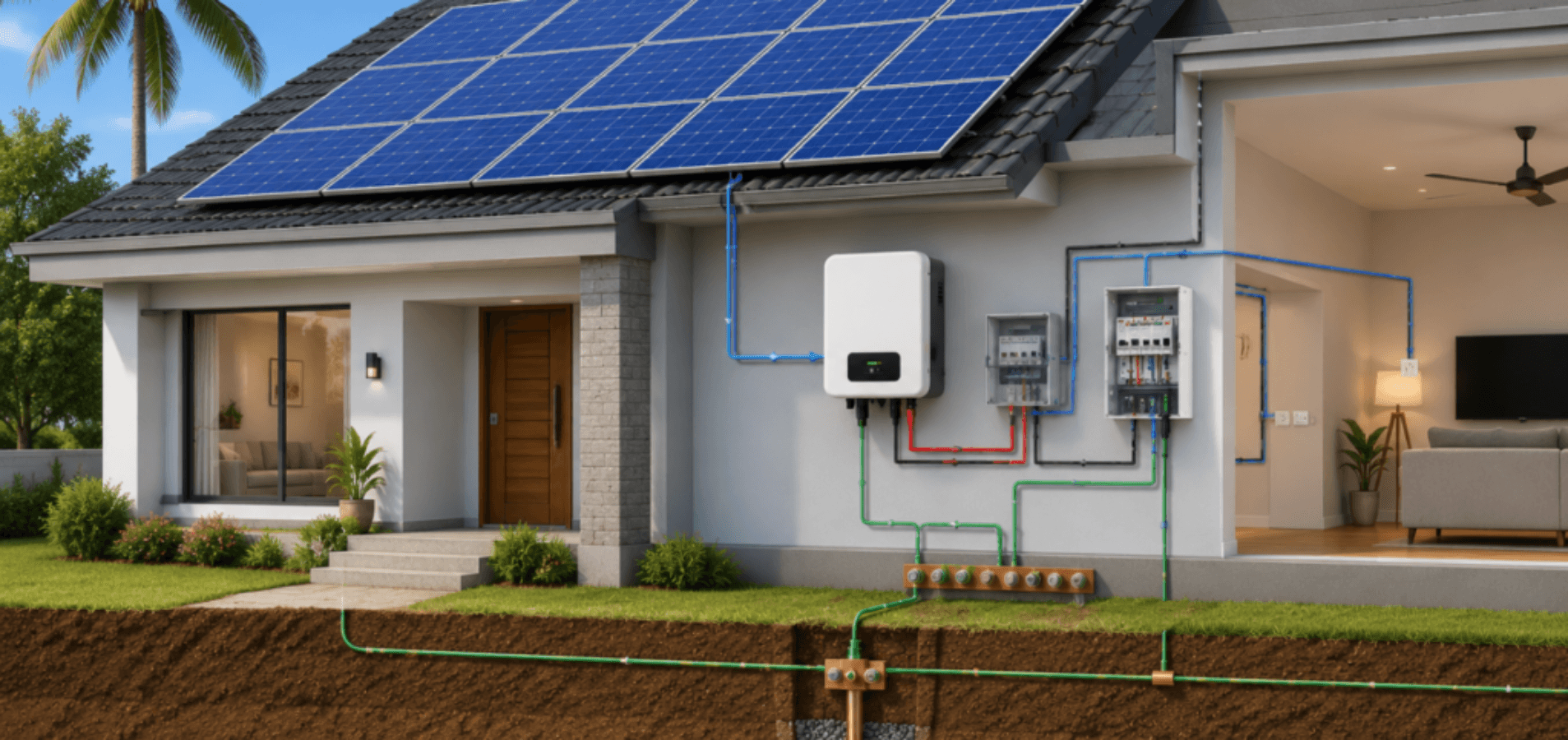
A complete earthing system for a solar PV installation typically includes the following elements:
1. DC fault currents are harder to interrupt
Unlike AC current, which crosses zero 50 times per second (allowing circuit breakers to extinguish arcs naturally), DC current is continuous. A DC arc, once formed, sustains itself until the source is physically disconnected or the energy is exhausted. Proper earthing ensures fault currents are directed away from people and toward protective devices that are rated for DC interruption.
2. The system stays live even during a grid outage
During a power cut, your solar array continues generating electricity as long as sunlight is present. Without earthing, a fault condition during an outage — when an electrician might assume the system is safe — can be lethal. Earthing does not de-energise the system, but it limits the touch voltage a person can be exposed to.
3. India’s climate creates elevated risk
High humidity, heavy monsoon rainfall, and salt-laden coastal air especially in Kerala and other states accelerate insulation degradation. As insulation fails over time, fault currents are more likely to flow through unintended paths — including through people. A robust earthing system provides the necessary fault path before insulation failure becomes a safety incident.
4. Rooftop installations are physically accessible
Unlike utility-scale installations behind fences, rooftop solar panels are within reach of homeowners, maintenance workers, and children. Panel frames, mounting rails, and inverter enclosures must be safely earthed to prevent any of these surfaces from becoming energised during a fault.
Earth Electrode (Earth Pit)
A copper or GI rod driven into the ground, providing the physical connection to earth. Soil resistivity determines depth and configuration.
Earthing Conductor
Bare or insulated copper conductor (typically 25–35 mm²) connecting the system to the earth electrode.
Panel Frame Bonding
Copper bonding cables connecting each panel frame to the mounting structure and then to the main earthing conductor.
Mounting Structure Earth
The entire racking/mounting system must be bonded and earthed as it is the largest metallic surface in a rooftop installation.
Inverter Earth Terminal
All inverters have a dedicated earth terminal. This must be connected with the correct conductor size as specified by the manufacturer.
Surge Protection Devices (SPDs)
Installed at the DC input and AC output of the inverter, SPDs divert lightning-induced transient voltages safely to earth.
Main Earthing Busbar
Collects all earth conductors from different parts of the system into a single point, which connects to the earth electrode.
Lightning protection: a separate but related requirement
Rooftop solar arrays significantly increase a building’s exposure to lightning risk — they are large, elevated metallic structures directly exposed to the sky. While earthing handles fault currents from internal electrical failures, a dedicated lightning protection system (LPS) is required to handle direct or nearby lightning strikes.
An LPS for a solar installation typically includes air termination rods (lightning rods) at the array perimeter, down conductors, and an earth termination network. The solar earthing system and the LPS must be coordinated to avoid dangerous potential differences during a strike event — a design requirement often missed in low-cost installations.
In Kerala, where thunderstorm activity is significant during the pre-monsoon and monsoon seasons, lightning protection is not a luxury — it is a necessary part of any permanent rooftop installation.
Applicable standards in India
Solar installations in India must comply with a combination of national and international standards. The key references for earthing and protection are:
IS 3043 : 2018
Code of practice for earthing — the primary Indian standard governing earthing system design, including electrode types, conductor sizing, and testing.
IS 15959 / IEC 62446
Requirements for PV system documentation, commissioning tests, and inspection, including earthing continuity verification.
CEA Technical Standards for Connectivity Regulations
Central Electricity Authority regulations governing grid-connected solar installations, including earthing and safety requirements.
IEC 62305
International standard for lightning protection, applicable where a Lightning Protection System (LPS) is required alongside the PV earthing system.
IEC 60364-7-712
Electrical installations in buildings — particular requirements for solar PV power supply systems.
Common earthing failures in rooftop solar installations
Field inspections of rooftop solar systems across India frequently reveal the following deficiencies. Each represents a real safety risk:
No earth pit installed: The earthing conductor is connected to a metal water pipe or a nearby earth point not designed for the purpose. This is both non-compliant and unreliable.
Undersized earthing conductor: Using 4 mm² or 6 mm² wire where the fault current calculations require 25 mm² or more. A conductor that cannot carry the fault current will melt or arc before the protective device operates.
Panel frames not bonded: Individual panel frames are left unearthed. In the event of an insulation fault within a panel, the frame becomes energised — and anyone touching it completes the circuit to earth through their body.
Mounting structure isolated from earthing system: The aluminium or GI mounting rail is not connected to the earthing conductor, creating a large floating metallic surface.
No SPDs installed: Without surge protection, a nearby lightning strike can propagate a destructive voltage surge through the DC wiring and destroy the inverter — or worse, cause a fire.
Earth electrode resistance not tested: An earth pit that was correctly installed may become ineffective as soil dries out or the electrode corrodes. Resistance should be measured at commissioning and periodically thereafter.
What to verify before accepting a solar installation
When your solar installation is complete, you have the right to ask for — and should insist on — the following documentation and tests:
An earth electrode resistance test result, measured with a dedicated earth tester (not estimated), confirming resistance below the standard threshold. Visual confirmation that all panel frames, mounting structures, and inverter enclosures are bonded and connected to the earthing system. Confirmation of SPD installation at both DC and AC sides. A single-line diagram showing the earthing arrangement. Compliance with IS 3043 and CEA regulations, confirmed in writing by the installer.
Any installer unwilling to provide these is either cutting costs at the expense of your safety, or lacks the technical competence to complete the work correctly. Neither is acceptable.
Summary
Earthing is not a bureaucratic formality. It is the mechanism that stands between a fault condition and a human casualty. In a well-designed solar installation, the earthing system operates silently in the background — you never notice it. In a poorly designed one, its absence may only become apparent when something goes seriously wrong.
When evaluating any solar proposal, ask specifically about the earthing design, the standards it complies with, and the test procedures that will be carried out at commissioning. A credible solar partner will answer these questions without hesitation.
This article is for informational purposes. Earthing system design must be carried out by a qualified electrical engineer in accordance with applicable standards and local regulations.
Kerala’s trusted wholesale supplier of solar panels, electrical accessories, earthing, meters, cables and distribution boards.
POLICY
Privacy Policy
Refund & Return
Terms & Condition
© 2026 Electric-Buy Trading. All Rights Reserved.