Cheap Solar Components vs Certified Components: The Hidden Long-Term Cost
Certification isn’t a marketing sticker. For solar components, it usually means the product has been tested against defined standards — BIS certification for panels and cables in India, IEC standards for performance and safety, and ALMM (Approved List of Models and Manufacturers) listing for panels used in subsidy-linked projects.
A certified component has been tested for:
- Actual power output matching the labeled wattage
- Performance under heat, humidity, and repeated thermal cycling
- Electrical safety (insulation, leakage current, fire resistance)
- Long-term degradation rate
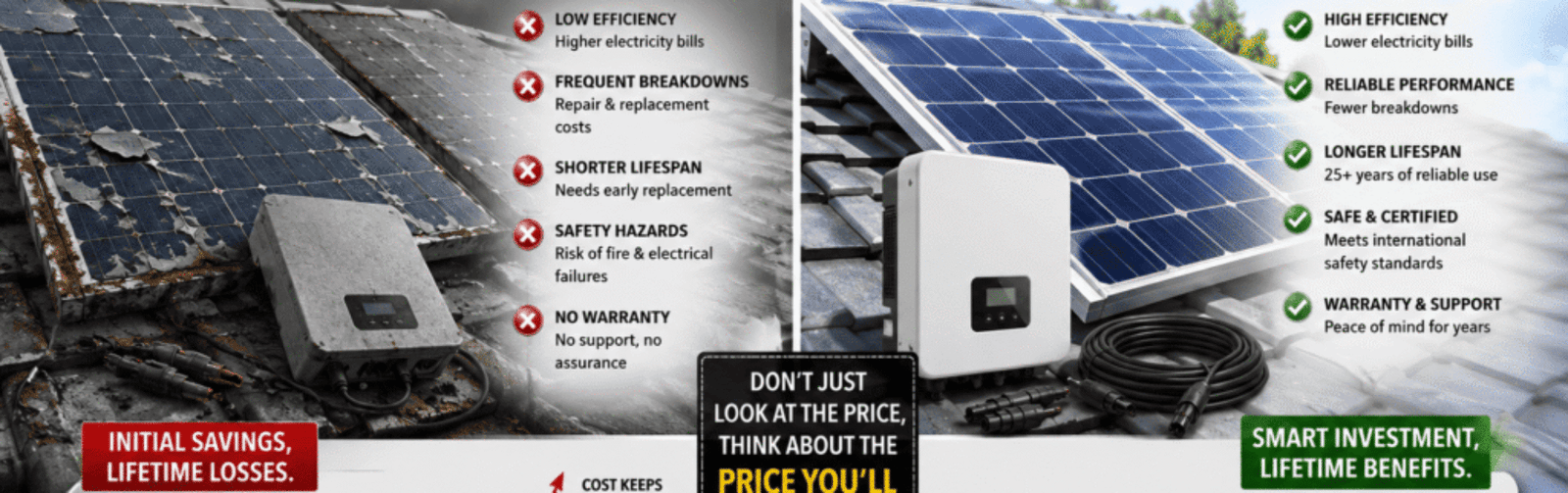
An uncertified or “grey market” component may look identical on a spec sheet but has none of this verified. The difference only becomes visible months or years after installation — which is exactly why it’s tempting to cut corners at the quoting stage.
Where the Hidden Costs Actually Show Up
1. Panels: Underperformance You Can’t See From the Datasheet
Non-certified panels are frequently sold with optimistic wattage ratings. A panel labeled 550W might genuinely deliver 550W under lab conditions — or it might be flash-tested selectively, with the actual field output running 5–10% lower. Multiply that across a rooftop array over 25 years and the shortfall in generation, and therefore in the client’s savings on their electricity bill, adds up to a number far larger than the money saved on the panel itself.
There’s also a degradation angle. Certified Mono PERC, TOPCon, and Bifacial panels come with manufacturer-backed degradation curves (typically under 0.5–0.6% per year for good-tier panels). Cheaper, uncertified panels degrade faster and less predictably, and if there’s no real manufacturer behind the product, there’s no one to claim against when output drops below the promised curve.
Non-DCR panels are a separate but related issue — they may be cheaper, but they’re not eligible for many subsidy schemes, and this category has already been phased out for many Kerala projects, which is worth mentioning to clients still asking about them.
2. Inverters: The Component Most Likely to Fail First
Inverters are the most electronically complex part of a solar system, which also makes them the most likely point of failure when quality is compromised. Cheaper inverters often use lower-grade capacitors and cooling designs that aren’t built for Kerala’s heat and humidity. The result is premature failure — sometimes within 2–4 years instead of the 8–10+ years expected from a well-built unit from an established brand.
An inverter replacement mid-cycle isn’t just a cost — it’s downtime, a site visit, and a client who now questions the installer’s judgment on everything else in the system.
3. Cables: The Risk That’s Invisible Until It’s Dangerous
Undersized or substandard AC/DC cabling is one of the least visible but most serious risks in a cheap-component system. Poor insulation, incorrect gauge for the current load, and non-UV-stabilized outdoor cable jacketing lead to voltage drop (which quietly reduces system efficiency) and, in worse cases, insulation breakdown and fire risk. Cable failures are also some of the hardest faults to diagnose after installation, since the wiring is usually hidden in conduit or under mounting structures.
4. Earthing Systems: Compliance Isn’t Optional
Earthing according to IS 3043 isn’t a nice-to-have — it’s a safety standard, and skipping proper earthing components to save cost creates real electric shock and equipment damage risk, particularly during Kerala’s monsoon months when moisture ingress is common. This is also one of the first things flagged in any post-installation safety audit, and a compliance gap here can expose both the contractor and the property owner to liability.
5. Mounting Structures: The Silent Failure Point
A mounting structure that isn’t properly rated for wind load or isn’t corrosion-resistant might look fine for the first year or two. In Kerala’s coastal districts, salt-air corrosion on cheap, non-galvanized structures can weaken the array’s physical support well before the panels themselves show any wear — leading to costly re-mounting work that could have been avoided with a properly coated structure from the start.
The Business Case for Certified Components (Not Just the Ethical One)
For EPCs and dealers, this isn’t only about doing right by the client — it’s a differentiator:
- Fewer callbacks. Certified components fail less often and more predictably, which means fewer emergency site visits eating into margins.
- Warranty backing that actually holds up. A claim against an established manufacturer with BIS/IEC certification is enforceable. A claim against an unbranded import often isn’t.
- Subsidy and compliance eligibility. Many government subsidy schemes require ALMM-listed panels and BIS-certified components — cheap, uncertified stock can disqualify a project entirely.
- Reputation compounding. In a relationship-driven B2B market like Kerala’s solar contractor network, one bad installation traveling by word of mouth costs more in lost future business than the margin gained from a cheaper build.
What This Means for Buyers
The practical takeaway for EPCs, solar dealers, and licensed electricians sourcing components: check for BIS certification on panels and cables, confirm ALMM listing where subsidy eligibility matters, and buy from a wholesale distributor who can show manufacturer backing — not just a low price. The cheapest quote on a component list is rarely the cheapest system over 25 years.
Use up and down arrow keys to resize the meta box pane.