Solar Installation Hardware Guide: Safety & Tips
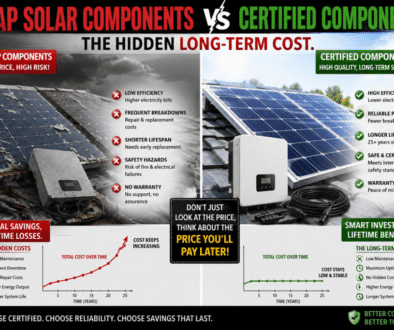
Panels and inverters get all the attention, but it is the cables, mounting structures, protection devices, and enclosures underneath that determine whether a solar installation is safe, durable, and legally compliant.
- Why hardware quality determines system lifespan
- AC and DC cables — the circulatory system of your solar plant
- Mounting structures, connectors & installation accessories
- MCB DBs, enclosures & distribution boards
- How the four hardware categories work together
- What to check before accepting any installation
When this hardware is correctly specified and installed, it operates invisibly for 25 years. When it is not — when a cable is undersized, a mounting rail corrodes, or a distribution board is left unenclosed — the consequences range from system underperformance to electrical fire.
This solar installation guide covers the four core hardware categories of any solar installation, what to look for in each, and why compromising on any one of them compromises the entire system.
1. AC and DC Cables — the circulatory system of your solar plant
Every watt your solar panels generate travels through cables before it reaches your load or the grid. The quality, sizing, and installation of those cables directly determines how much energy is lost, how safe the system is, and how long it lasts.
DC cables: From Panel To Inverter
The DC side of a solar system — from panels to the inverter — carries continuous high-voltage direct current. This is fundamentally different from household AC wiring. DC cables used in solar installations must be rated for the specific voltage of the array (typically 600V to 1500V DC), must be UV-resistant since they are exposed to direct sunlight on the rooftop, and must be double-insulated to prevent faults in the harsh rooftop environment.
Standard household wiring cables are not suitable for solar DC applications. Using undersized or unrated cables on the DC side creates resistive losses that reduce system output and, in a fault condition, can cause sustained arcing — one of the leading causes of solar system fires.
AC cables: From Inverter To Grid Or Load
The AC output side of the inverter connects to your building’s distribution system and, in a grid-tied installation, to the KSEB meter. AC cable sizing must account for the inverter’s full output current, the cable run length, and the ambient temperature — longer runs and higher temperatures both increase effective resistance and require upsizing.
In Kerala’s climate, cables installed in conduits or trunkings in areas exposed to direct sun can reach significantly elevated temperatures. Cable current ratings are typically specified at 30°C ambient; at 50°C, the same cable must be derated. An installer who sizes cables without accounting for temperature is overloading them from day one.
Why Proper Cable Sizing Matters
A 1% voltage drop on the DC string can reduce annual energy yield by 1%. Over a 25-year system lifespan, this translates into a measurable financial loss from a component that costs very little to upsize during installation. Investing in properly sized cables helps maximize system efficiency, energy production, and long-term return on investment.
Solar DC String Cable
Application
Panel to combiner box or inverter
Key Requirement
UV resistant, double insulated, DC voltage rated (600–1500V).
AC Output Cable
Application
Inverter to DB or grid connection
Key Requirement
Sized for inverter output current with temperature derating.
Earthing Conductor
Application
Panel frames, inverter, and structure to earth
Key Requirement
Bare or green/yellow insulated copper, sized per IS 3043.
Battery Interconnect Cable
Application
Battery bank to inverter (hybrid systems)
Key Requirement
Flexible, short run, and very high current rated.
2. Mounting Structures, Connectors & Installation Accessories
The mounting structure is the physical foundation of your solar installation. It holds panels at the correct angle, transfers wind and dead loads to the building structure, and forms the largest metallic surface in the system — which must be properly bonded and earthed as part of a complete solar earthing system.
DC cables: From Panel To Inverter
The DC side of a solar system — from panels to the inverter — carries continuous high-voltage direct current. This is fundamentally different from household AC wiring. DC cables used in solar installations must be rated for the specific voltage of the array (typically 600V to 1500V DC), must be UV-resistant since they are exposed to direct sunlight on the rooftop, and must be double-insulated to prevent faults in the harsh rooftop environment.
Standard household wiring cables are not suitable for solar DC applications. Using undersized or unrated cables on the DC side creates resistive losses that reduce system output and, in a fault condition, can cause sustained arcing — one of the leading causes of solar system fires.
AC cables: From Inverter To Grid Or Load
The AC output side of the inverter connects to your building’s distribution system and, in a grid-tied installation, to the KSEB meter. AC cable sizing must account for the inverter’s full output current, the cable run length, and the ambient temperature — longer runs and higher temperatures both increase effective resistance and require upsizing.
In Kerala’s climate, cables installed in conduits or trunkings in areas exposed to direct sun can reach significantly elevated temperatures. Cable current ratings are typically specified at 30°C ambient; at 50°C, the same cable must be derated. An installer who sizes cables without accounting for temperature is overloading them from day one.
Why Proper Cable Sizing Matters
A 1% voltage drop on the DC string can reduce annual energy yield by 1%. Over a 25-year system lifespan, this translates into a measurable financial loss from a component that costs very little to upsize during installation. Investing in properly sized cables helps maximize system efficiency, energy production, and long-term return on investment.
Solar DC String Cable
Application
Panel to combiner box or inverter
Key Requirement
UV resistant, double insulated, DC voltage rated (600–1500V).
AC Output Cable
Application
Inverter to DB or grid connection
Key Requirement
Sized for inverter output current with temperature derating.
Earthing Conductor
Application
Panel frames, inverter, and structure to earth
Key Requirement
Bare or green/yellow insulated copper, sized per IS 3043.
Battery Interconnect Cable
Application
Battery bank to inverter (hybrid systems)
Key Requirement
Flexible, short run, and very high current rated.
Mounting structures
Rooftop mounting systems in India are typically fabricated from either hot-dip galvanised steel or anodised aluminium. Both are suitable, but they have different characteristics relevant to Kerala’s coastal and humid environment. Aluminium is lighter, easier to install, and naturally corrosion-resistant. Galvanised steel is stronger for heavy loads but requires intact zinc coating — any cut edge or drilled hole that exposes bare steel will begin rusting quickly in coastal conditions.
The tilt angle of the mounting structure also matters. In Kerala (approximately 8–12°N latitude), an optimal fixed tilt of around 10–15° maximises annual energy yield. Many low-cost installations use whatever angle is convenient rather than what is optimal, leaving meaningful generation on the table every day for 25 years.
MC4 connectors and junction accessories
MC4 connectors are the standard DC-side connectors used to join solar panel strings. They are designed for a single mating cycle — connect once, leave connected. Using damaged, mismatched, or non-IP67-rated MC4 connectors is a significant fire risk, particularly in Kerala where thermal cycling from monsoon rains to summer heat causes repeated expansion and contraction that can loosen poor connections over time.
Junction boxes, cable glands, conduit fittings, cable ties, and saddle clips make up the rest of the installation accessories category. These are unglamorous components that rarely appear in sales quotations but are essential to a neat, code-compliant, weather-resistant installation.
Mounting Rails
Material (aluminium or hot-dip GI), wall thickness, and load rating.
Roof Hooks / Clamps
Compatibility with roof type (RCC, Mangalore tile, metal sheet).
MC4 Connectors
IP67 rating, TÜV certification, and compatibility with solar panels.
Junction Boxes
Minimum IP65 rating for outdoor use and correct cable gland sizing.
Cable Management
UV-stabilised ties, saddles, and conduit protection where required.
3. MCB DBs, Metal & Plastic Enclosures
Protection and enclosure hardware is where electrical safety becomes physical. MCBs, DC and AC distribution boards, and their enclosures are the components that interrupt fault currents, isolate circuits for maintenance, and house live connections safely away from accidental contact.
DC Distribution Boards (DCDB)
The DCDB sits between the solar array and the inverter. It houses DC MCBs or fuses for each string, a DC surge protection device (SPD), and sometimes a DC isolator. Its purpose is to allow individual strings to be isolated for fault-finding, and to protect the inverter from overcurrent and lightning-induced surges arriving from the array.
A critical point often missed: standard AC MCBs cannot be used on the DC side of a solar system. DC current does not cross zero — arcs do not self-extinguish the way they do in AC. DC-rated MCBs have enhanced arc extinguishing chambers specifically designed for this application. Using AC MCBs in a DCDB is a non-compliant and potentially dangerous substitution.
AC Distribution Boards (ACDB)
The ACDB sits between the inverter output and the building’s main distribution board or the KSEB grid connection point. It houses AC MCBs, an AC SPD, and energy metering provisions. In net metering installations, the ACDB arrangement must comply with KSEB’s technical requirements for grid connectivity.
Metal Vs Plastic Enclosures
Both metal and plastic enclosures are used in solar installations, and each has appropriate applications. Metal enclosures offer superior mechanical protection and heat dissipation, preferred for industrial and outdoor installations. They must be earthed. Plastic enclosures (polycarbonate or ABS) are lighter, inherently non-conductive, and corrosion-resistant — making them well suited for humid Kerala environments. IP rating matters more than material: any outdoor enclosure should be at minimum IP65.
DC MCB
Solar Application
String protection in DCDB
Key Spec
Must be DC-rated (800V or 1000V DC); not interchangeable with AC MCBs.
AC MCB
Solar Application
Output protection in ACDB
Key Spec
Rated for inverter output current; Type B or Type C curve as appropriate.
DC SPD
Solar Application
Lightning protection, DC side
Key Spec
Class II SPD rated for the solar array open-circuit voltage.
AC SPD
Solar Application
Lightning protection, AC side
Key Spec
Class II SPD rated for 230V/415V AC systems.
Metal Enclosure
Solar Application
DCDB/ACDB housing for industrial use
Key Spec
Powder-coated, IP65 rated for outdoor installation, and properly earthed.
Plastic Enclosure
Solar Application
DCDB/ACDB housing in humid environments
Key Spec
Polycarbonate or ABS construction with a minimum IP65 rating.
4. How the four hardware categories work together
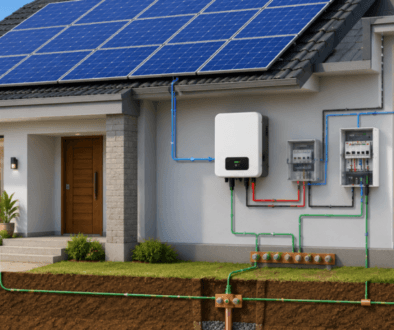
A solar installation is a system, and its safety and performance are only as good as the weakest hardware link. Panels mounted on a correctly specified mounting structure generate DC current that flows through rated DC cables into a DCDB housed in a sealed enclosure, where string fuses and surge protection guard the inverter. The inverter converts DC to AC, which flows through correctly sized AC cables into an ACDB, from where it feeds the building loads or the KSEB grid. Throughout, the mounting structure, panel frames, inverter enclosure, and both DBs are bonded and connected to earth via the earthing conductor.
Remove or compromise any one of these elements and the system has a gap — in protection, in performance, or in compliance.
5. What to verify before accepting any installation
Cables: DC cables are solar-rated, sized per the string current with temperature derating applied, and UV-protected along their entire run. AC cables are sized for the inverter’s rated output with an appropriate safety margin.
Mounting structure: Material and coating are appropriate for the roof type and location. Tilt angle is within 5° of the latitude-optimal angle. All MC4 connections are fully seated and locked. Cable management prevents chafing, pooling water, and direct sunlight contact with non-UV-rated components.
MCBs and DBs: DC-side MCBs are DC-rated. Both DC and AC SPDs are installed. All distribution boards are in sealed enclosures with appropriate IP ratings. All enclosures are earthed. The ACDB arrangement is compliant with KSEB net metering requirements.
An installer who cannot clearly answer questions about cable sizing, DC versus AC MCB ratings, or enclosure IP ratings is not in a position to deliver a safe installation — regardless of the panel and inverter brands on the quotation.
Kerala’s trusted wholesale supplier of solar panels, electrical accessories, earthing, meters, cables and distribution boards.
POLICY
Privacy Policy
Refund & Return
Terms & Condition
© 2026 Electric-Buy Trading. All Rights Reserved.